Constipation and the Gut Microbiome
How your gut community shapes transit time — and what actually gets things moving.
Constipation is usually treated as a plumbing problem: not enough fiber, not enough water, not enough movement. All true. But underneath the mechanics is an ecosystem. The same microbes that ferment your food also help set the pace at which it travels — and when that community is out of balance, transit can slow to a crawl.
Transit time is a microbial conversation
Food doesn't move through you on a fixed schedule. How fast it travels — what researchers call transit time — is shaped by a constant back-and-forth between your nervous system, your gut muscles, and the bacteria living in your colon. Slow that conversation down and stool spends longer in the colon, where more water is reabsorbed and it becomes harder and drier to pass.
Studies that measure transit time alongside microbiome composition find the two are linked: slower transit tends to track with a different microbial mix and, often, lower overall diversity. The gut and its microbes are setting the tempo together.
Short-chain fatty acids and the gut's rhythm
When gut bacteria ferment fiber, they produce short-chain fatty acids — chiefly butyrate, acetate, and propionate. Beyond feeding the cells of your colon, these compounds help stimulate the wave-like muscle contractions, called peristalsis, that move stool along.
A microbiome starved of fermentable fiber makes fewer of these signaling molecules. Less fuel, fewer signals, and a colon that has less prompting to keep things moving. It's one reason a low-fiber diet so reliably slows things down.
Water, fiber, and the kind that matters
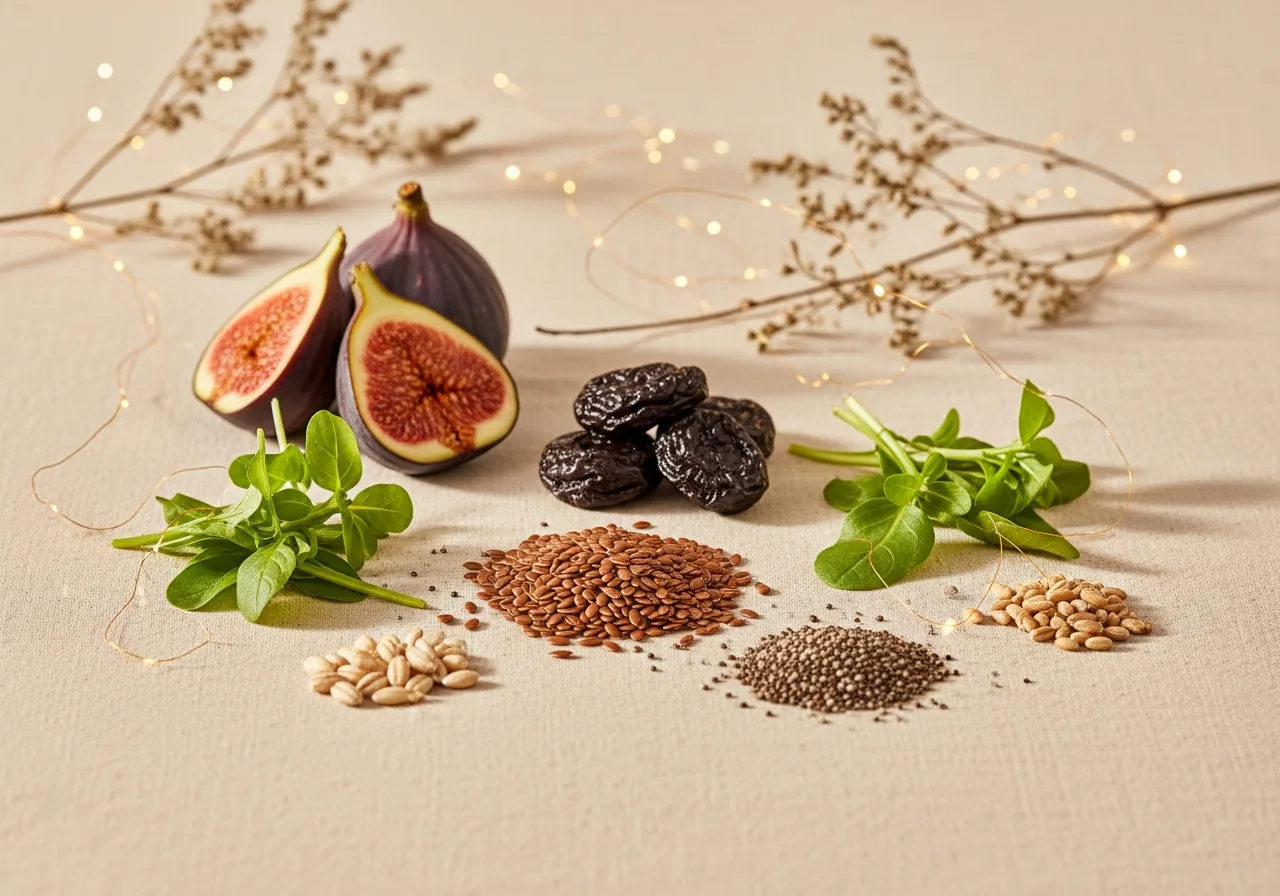
Not all fiber behaves the same way. Soluble fibers and certain fermentable fibers draw in water and feed your microbes; insoluble fiber adds bulk that helps stimulate movement. Most people do best with a mix from a wide range of plants rather than a single supplement.
Hydration matters because fiber works with water, not instead of it. Loading up on fiber while underhydrated can occasionally make things feel worse before they get better — the goal is bulkier, softer, easier-to-pass stool, and that needs water in the equation.
Where ferments fit — gently
Live fermented foods bring both fibers and live cultures to the table, and a more diverse, well-fed microbiome is generally a better-regulated one. Some people find that consistent fermented foods, alongside more whole-plant fiber, support more comfortable regularity over time.
As always, go gradually. Ramp up fiber and ferments slowly, drink enough water, and give your gut community a couple of weeks to adjust. And if constipation is sudden, severe, or persistent, that's a conversation for a clinician — not a kitchen experiment.
- Transit time — how fast food moves through you — is shaped by your gut microbes, not just fiber and water.
- Bacteria ferment fiber into short-chain fatty acids that help drive the muscle contractions moving stool along.
- Build regularity with a wide range of plant fibers, enough water, and live fermented foods — added gradually.
- 1.Asnicar F, Leeming ER, Segata N, Spector TD, Berry SE (2021). Blue poo: impact of gut transit time on the gut microbiome using a novel marker. Gut.
- 2.Vandeputte D, Falony G, Vieira-Silva S, et al. (2016). Stool consistency is strongly associated with gut microbiota richness and composition. Gut.
- 3.Yang J, Wang HP, Zhou L, Xu CF (2012). Effect of dietary fiber on constipation: a meta-analysis. World Journal of Gastroenterology.
- 4.Dimidi E, Christodoulides S, Scott SM, Whelan K (2017). Mechanisms of action of probiotics and the gastrointestinal microbiota on gut motility and constipation. Advances in Nutrition.
Wild Origin makes food, not medicine. This article is for curiosity and education — it is not medical advice, and our products are not intended to diagnose, treat, cure, or prevent any disease. If you are managing a health condition, talk to a qualified clinician.
Why Your Microbiome Matters
The trillions of microbes living inside you — and what they actually do.