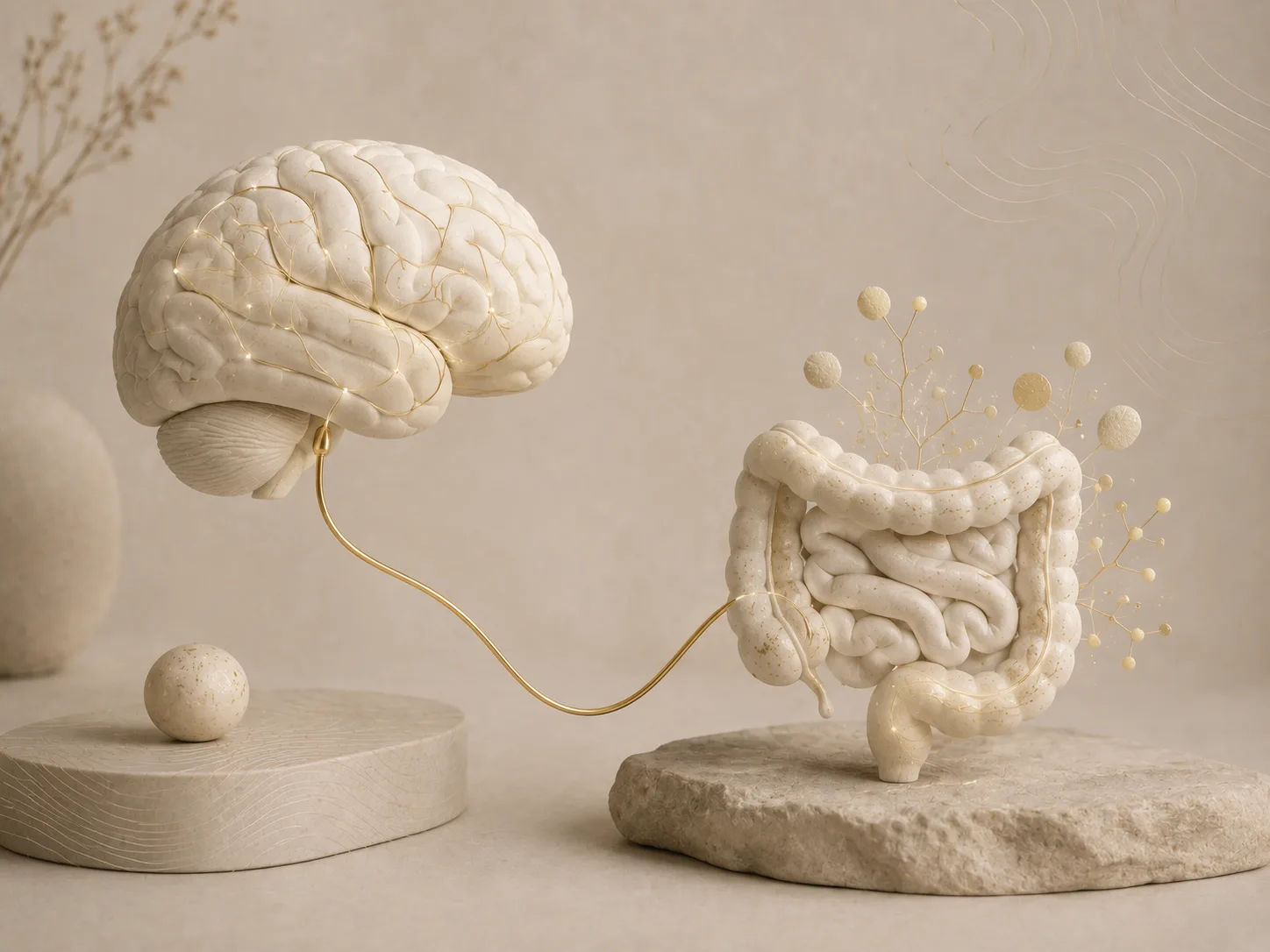
The Gut–Brain Axis
How your gut and your brain stay in constant conversation.
The feeling in your gut isn't only a metaphor. Your digestive tract and your brain are wired together through nerves, hormones, immune signals, and the chemical output of your microbes — a bidirectional system researchers call the gut–brain axis.
A two-way highway
Lining your gut is the enteric nervous system: a mesh of roughly 500 million neurons, sometimes called the "second brain," capable of operating largely on its own. It talks to your head primarily through the vagus nerve, a direct line carrying signals in both directions — far more of them traveling gut-to-brain than the other way around.
Alongside that wiring run two more channels: the immune system, which the gut microbiome helps calibrate, and the bloodstream, which carries microbial metabolites and hormones that the brain can read.
Microbes that make neuroactive molecules
Around 90–95% of the body's serotonin is produced in the gut. Gut bacteria don't just sit near this chemistry — they influence it, nudging the production of serotonin precursors and other neuroactive compounds like GABA and dopamine-related molecules.
The short-chain fatty acids produced when bacteria ferment fiber appear to be part of the signal too, influencing the gut lining, the immune system, and pathways that reach the brain.
Why it matters day to day
Stress changes the microbiome, and the microbiome shapes how you respond to stress — a genuine feedback loop. In germ-free animals raised without any microbes, stress responses and brain development are measurably altered, then partly normalized when microbes are reintroduced.
In humans the picture is still being mapped, but the direction is clear: how you feed and care for your gut is plausibly one input into how you feel.
- The gut and brain communicate constantly through the vagus nerve, immune system, and microbial metabolites.
- Most of the body's serotonin is made in the gut, and microbes help shape that chemistry.
- Stress and the microbiome influence each other in a two-way loop.
- 1.Cryan JF, Dinan TG (2012). Mind-altering microorganisms: the impact of the gut microbiota on brain and behaviour. Nature Reviews Neuroscience.
- 2.Cryan JF, O'Riordan KJ, Cowan CSM, et al. (2019). The microbiota-gut-brain axis. Physiological Reviews.
- 3.Mayer EA (2011). Gut feelings: the emerging biology of gut-brain communication. Nature Reviews Neuroscience.
Wild Origin makes food, not medicine. This article is for curiosity and education — it is not medical advice, and our products are not intended to diagnose, treat, cure, or prevent any disease. If you are managing a health condition, talk to a qualified clinician.

Your Gut and Your Mood
The emerging links between the microbiome, depression, and anxiety.

Why Your Microbiome Matters
The trillions of microbes living inside you — and what they actually do.