The Microbiology of a Kiss
A ten-second kiss swaps around 80 million bacteria — here's what you're really sharing with a partner.
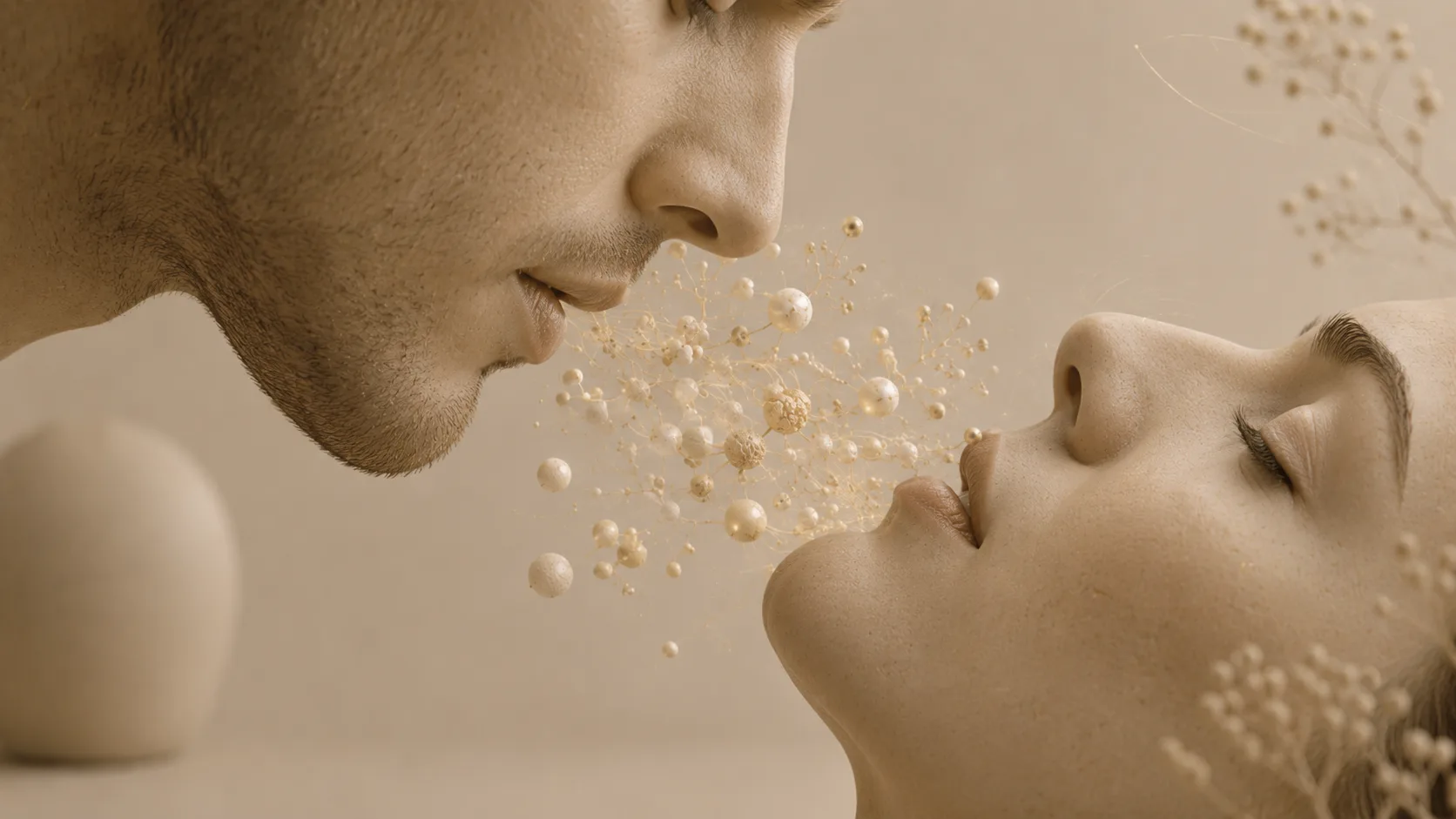
Lean in for ten seconds and you trade roughly 80 million bacteria. A kiss isn't only an act of affection — it's a measurable exchange of living microbes, a quiet handoff between two ecosystems. The more a couple kisses, the more their resident microbial communities begin to resemble one another.
Eighty million, ten seconds
The number isn't a flourish — it comes from a 2014 study in which researchers measured the bacteria transferred during a single intimate kiss. A ten-second kiss moved on the order of 80 million bacteria between partners, a vivid reminder that your mouth is a teeming habitat, not a sterile one.
The same work found that couples who kissed more frequently shared more similar oral microbiomes overall. Closeness, it turns out, is something you can read in the bacteria — partners converge toward a shared community the more often they connect.
What you give, and what you get
A kiss runs in both directions. You seed your partner's mouth with your own microbes, and you take on theirs in the same breath — a genuine two-way exchange rather than a one-sided gift. Over time, that shared contact nudges both partners' oral communities toward a common middle ground.
Most of what moves is the everyday, harmless flora that lives in any healthy mouth. Exposure to a partner's microbes is part of how two people's bodies acclimate to sharing a life — the same way cohabiting partners gradually come to share microbes far beyond the lips.
The mouth is a doorway to the gut
Your oral microbiome and your gut microbiome aren't sealed off from each other. The mouth is the front door of the digestive tract, and microbes that establish there can travel downstream, which is part of why oral health keeps turning up in conversations about whole-body health.
So while a kiss is most directly an exchange of oral bacteria, it sits within a larger picture: partners who live together share microbial signatures across skin, mouth, and gut alike. Intimacy, in the most literal biological sense, is a blending of ecosystems.
Is sharing microbes a good thing?
Mostly, it's simply life. A diverse, well-fed microbiome is a resilient one, and exposure to another person's harmless flora is one of the countless ways your community stays varied. There's no need to romanticize or fear it — it's the ordinary biology of being close to someone.
The honest caveat: the same closeness that shares friendly microbes can also pass along the unwelcome ones, from cold viruses to the bacteria behind cavities. None of that is a reason to kiss less — just a reminder that an exchange this intimate is, by nature, a shared responsibility.
- A ten-second intimate kiss transfers roughly 80 million bacteria between partners.
- Couples who kiss more often develop more similar oral microbiomes over time.
- A kiss is a two-way exchange — and the mouth connects to the wider gut ecosystem.
- 1.Kort R, Caspers M, van de Graaf A, et al. (2014). Shaping the oral microbiota through intimate kissing. Microbiome.
- 2.Song SJ, Lauber C, Costello EK, et al. (2013). Cohabiting family members share microbiota with one another and with their dogs. eLife.
- 3.Ross AA, Doxey AC, Neufeld JD (2017). The skin microbiome of cohabiting couples. mSystems.
Wild Origin makes food, not medicine. This article is for curiosity and education — it is not medical advice, and our products are not intended to diagnose, treat, cure, or prevent any disease. If you are managing a health condition, talk to a qualified clinician.
Why Your Microbiome Matters
The trillions of microbes living inside you — and what they actually do.
The Gut–Brain Axis
How your gut and your brain stay in constant conversation.